

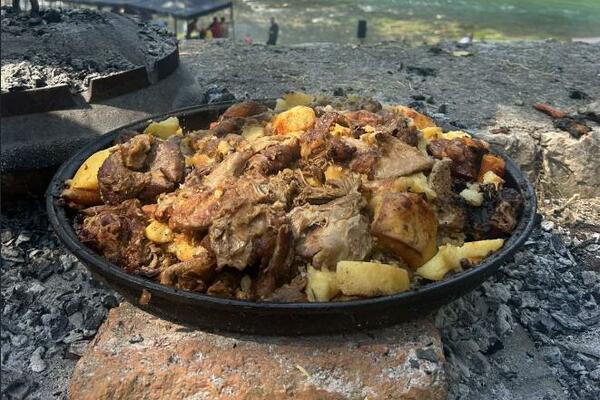

On the banks of the Zeta river in Danilovgrad, beneath the Radovan Pavićević bridge, 92 teams from Montenegro and across the region gathered on Saturday for the third international Sač Fest.
The competition centred on a single dish: veal cooked under the sač. What sounds narrow is in fact the foundation of Montenegrin cooking, and the festival has grown each year into one of the country's most distinctive food events.
Alongside the competition, this year's edition carried a charitable dimension, with an entertainment programme running through the day for visitors.
What the Sač Actually Is
For visitors unfamiliar with the method, the sač is a heavy bell-shaped lid, traditionally made of cast iron or fired clay. Food is placed in a shallow pan over an open hearth, the sač is lowered over it, and hot embers and ash are heaped on top and around the edges until the dish is completely sealed in.
What happens next is closer to a slow oven than a grill. Heat radiates from every direction at once, moisture cannot escape, and the meat cooks in its own juices for two to three hours. The result is meat that falls off the bone, with potatoes cooked underneath in the rendered fat.
The technique predates ovens in this part of the world by centuries and has never really been replaced. Most rural households in Montenegro still own a sač, and it remains the standard method for feeding a large group on a significant occasion — a saint's day, a wedding, a family gathering.
Veal is the classic choice, though lamb is equally traditional, and bread baked under the sač is a category of its own.

Why the Festival Has Grown
The event's expansion reflects something broader in Montenegrin tourism. Food traditions that were once simply everyday practice have become, in the last decade, a genuine draw for visitors seeking something beyond the coast.
Ninety-two competing teams is a substantial field for a country of 620,000 people, and the international participation points to how widely the technique is shared across the region. Cooking under the sač is common throughout the Western Balkans, with local variations in seasoning, cut of meat and the ratio of vegetables to meat, which gives a competition of this kind a real basis for comparison.
The organisers frame the festival around three goals: promoting traditional cuisine, bringing people together, and drawing attention to Danilovgrad's tourism potential. On the evidence of attendance, all three are working.

Danilovgrad, the Town Most Visitors Miss
Danilovgrad sits in the Bjelopavlići valley between Podgorica and Nikšić, roughly 20 minutes from the capital. It is one of Montenegro's smaller municipalities and receives a fraction of the international attention directed at the coast.
That is a gap worth closing. The town sits on the Zeta river, one of the cleanest in the country, with swimming spots and riverside walks that locals use heavily through summer. The surrounding valley is the agricultural heart of central Montenegro, which is precisely why a food festival makes sense here.
Danilovgrad is also known for its stonemasonry tradition, with a long history of quarrying and carving that supplied buildings across the region. The Ostrog Monastery, one of the most visited pilgrimage sites in the Balkans, sits within the municipality's territory — carved into a vertical cliff face and drawing hundreds of thousands of visitors a year, many of whom pass through without stopping in the town itself.
For travellers driving between Podgorica and the northern mountains, it is an easy and rewarding detour.

Where to Try Meat Under the Sač
The festival is annual, but the dish is available year-round for visitors who know where to look.
Traditional restaurants throughout central and northern Montenegro serve meat under the sač, though it typically requires ordering in advance — usually a few hours, sometimes a day. The cooking time cannot be shortened, so restaurants prepare it to order rather than keeping it ready.
Konobas and rural guesthouses in the Bjelopavlići valley, around Nikšić, and in the mountain regions near Kolašin and Žabljak are the most reliable places to find it done properly. Many family-run accommodations will prepare it for guests on request, which is often the best version available.
Expect to pay roughly €15-€25 per person, and expect a portion sized for people who have been working outdoors. It is a dish built for sharing, and ordering it for one is missing the point.
Pogledajte još:
Preuzmi aplikaciju i prati vijesti


PRATITE NAS NA