

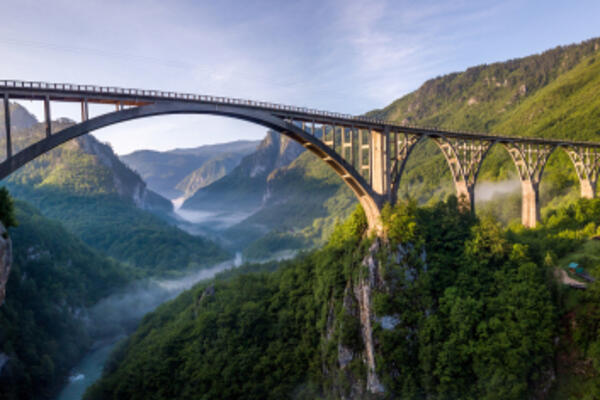

For travelers who haven't visited yet, the question is a fair one: what is it about Montenegro that keeps drawing this kind of attention? Here's a look at what BBC Travel highlighted, what else deserves your time, and how to plan a trip that gets past the postcard version.
Why Montenegro Made the List
BBC Travel pointed to a familiar combination: dramatic landscapes packed into a small territory, a coastline of Venetian-era towns, and a growing reputation for sustainable travel. The country has only around 620,000 people and is one of the smallest in Europe, but it contains five national parks, the deepest canyon in Europe, and a stretch of Adriatic coast that has been compared to Italy and Croatia for centuries.

The piece focused on the Bay of Kotor, the UNESCO-listed inlet often described as one of Europe's most beautiful natural harbors. It also mentioned Lovćen, the mountain that gives the country its name, and Skadar Lake, the largest lake in the Balkans, shared with Albania.
BBC Travel framed Montenegro as a destination that rewards slower travel, and that framing matters. Visitors who try to see everything in three days tend to leave underwhelmed. Those who pick a base and explore from there often come back.
What the Coast Offers
The Adriatic coastline runs roughly 295 kilometers from Herceg Novi in the west to Ulcinj in the south. Each section has its own character.

The Bay of Kotor combines steep mountains with calm, fjord-like waters. Kotor's old town is the headline attraction, with city walls climbing up to a fortress that offers some of the best views in the Adriatic. Perast, a smaller town nearby, is a favorite for half-day visits and boat trips to the two small islands in the bay.
Further south, Budva is the country's main resort town, with the largest concentration of hotels, restaurants, and nightlife. The medieval old town sits on a small peninsula, and beaches like Mogren and Jaz draw heavy summer crowds.

Ulcinj, near the Albanian border, has a distinct Mediterranean-Levantine feel, with the longest sandy beach on the Adriatic at Velika Plaža and a lively old town that reflects centuries of Ottoman influence.
The Mountains and the North
Many international visitors miss the northern half of the country, which is a shame, because it contains some of the most striking landscapes in the Balkans.
Durmitor National Park, centered on the town of Žabljak, is the most popular mountain destination. It offers hiking in summer, skiing in winter, and the Tara Canyon, which at over 1,300 meters deep is the second-deepest canyon in the world after the Grand Canyon. Rafting trips on the Tara River are a regional classic and run from spring through autumn.

Biogradska Gora, between Kolašin and Mojkovac, protects one of the last three primeval forests in Europe. Its centerpiece, Biograd Lake, is reachable by car and surrounded by easy walking trails suitable for casual visitors.
Prokletije in the far northeast, near the Albanian and Kosovan borders, is the wildest of the parks. It sees fewer visitors and offers serious hiking through some of the highest peaks in the Dinaric Alps.
Beyond the Headlines

Several places worth knowing don't always make international travel coverage but add depth to any trip.
Cetinje, the historical royal capital, sits in a valley about 30 minutes from Budva. It's quiet, atmospheric, and home to the country's most important museums, monasteries, and the former royal court. A growing arts scene has made it a quietly interesting day trip.
Lipa Cave near Cetinje is one of the country's largest accessible cave systems, with guided tours and a small electric train that runs through one of the chambers.
The Crmnica wine region around Skadar Lake produces Vranac, the country's signature red grape, and Krstač, a local white. Several family wineries near Virpazar welcome visitors for tastings and traditional meals.

Plav and Gusinje in the northeast are small, multi-ethnic towns at the foot of the Prokletije mountains. The food, architecture, and pace of life are different from anywhere else in the country, and the area offers excellent hiking with very few tourists.
Practical Tips for First-Time Visitors
The country is compact enough that travelers can see a lot in a week, but the roads slow things down. Mountain routes are scenic and winding, and reaching the north from the coast typically takes three to four hours.
Renting a car is the most flexible way to explore. Public buses connect the main towns reliably but reach fewer rural destinations. The Belgrade-Bar railway offers one of the most scenic train rides in Europe and is worth considering for the journey alone.
Peak season runs from late June to the end of August, when the coast is crowded and prices roughly double. May, June, September, and early October are widely considered the best months to visit. The weather is warm enough for swimming, the towns are open and lively, and crowds are manageable.
English is widely spoken in tourist areas, less so in inland villages and northern towns. Learning a few basic Montenegrin phrases is appreciated, and locals are generally patient with visitors who try.
Making the Most of the BBC Pick
A BBC Travel mention typically brings a wave of new visitors, and Montenegro is likely to be busier in 2026 than in recent years. For travelers planning a trip, that makes a few decisions more important.
Booking accommodation in advance is essential for July and August, especially in Kotor, Perast, and Budva. Shoulder-season visits are the easier option and arguably the better one. They reveal more of the country's everyday rhythm and make it easier to engage with locals who aren't running flat-out.
Splitting time between the coast and the mountains is a useful strategy, even on a short trip. Three days on the bay and three days in the north gives a much fuller picture than six days on the beach. The contrast is part of what BBC Travel was pointing to in the first place.
The country lives up to its growing reputation, but it rewards travelers who treat it as more than a single destination. Montenegro is a collection of regions, each with its own food, dialect, landscape, and history. Treating it that way is the most reliable path to a great trip.
Pogledajte još:
Preuzmi aplikaciju i prati vijesti


PRATITE NAS NA